Measurement and Evaluation Unit

About the Unit

The Measurement and Evaluation Unit at the Faculty of Nursing – Helwan University is a cornerstone unit that contributes to ensuring and developing the quality of the educational process. It achieves this by designing effective and fair evaluation tools and accurately and objectively measuring learning outcomes.

The unit aims to support faculty members in preparing question banks according to academic standards and analyzing examination results to reflect student achievement and contribute to improving educational performance. Furthermore, the unit strives to disseminate a culture of objective, evidence-based evaluation and to offer workshops and training programs that enhance the competency of faculty members in the fields of measurement and evaluation.

The unit is committed to upholding principles of fairness and transparency in evaluation. This commitment supports the development of academic programs and the achievement of learning outcomes that align with quality requirements and academic accreditation.

Unit Vision

The Measurement and Evaluation Unit strives for excellence within the college in student assessment and examination procedures. We aim to achieve this by utilizing the latest appropriate and effective technologies and methodologies, ensuring our graduates reach distinguished academic and global standards.

 Unit Mission

The Measurement and Evaluation Unit is committed to ensuring speed, accuracy, and transparency in all student examination procedures within the college. We apply specific assessment standards as a prerequisite to guarantee the quality of graduates, enabling them to effectively serve society and compete in the local and regional job markets.

Image
Objectives of the Measurement and Evaluation Unit

The Measurement and Evaluation Unit aims to achieve the following:

  • Promote modern assessment methods: Disseminate contemporary evaluation techniques and tools, embracing innovative approaches to assessment.

  • Ensure fairness and efficiency in evaluations: Achieve speed, accuracy, transparency, and fairness in all assessment activities, including oral examinations and specifications.

  • Develop an electronic question bank: Establish a comprehensive electronic question bank for the college.

  • Enhance integrated e-management: Confirm the effectiveness of integrated electronic management, which encompasses the quality of the teaching and learning environment within the college.

  • Validate mechanization systems: Ensure the validity of mechanized systems that reflect desired behaviors.

  • Build structured question banks: Construct organized question banks that accurately reflect targeted behaviors and the extent to which academic standards are met within the college.

  • Utilize examination standards programs: Benefit from programs related to examination standards and specifications.

  • Develop unit plans: Formulate strategic plans for the unit's operations.

  • Design assessment models for quality: Create models for evaluating teaching and learning to ensure quality.

  • Review and evaluate academic programs: Assess and review the college's educational programs.

  • Evaluate student learning and examinations: Conduct student learning assessments and examinations in alignment with quality and accreditation standards.

  • Analyze curricula for educational objectives: Study various student courses to evaluate their educational objectives and the program's academic standards, and utilize e-courses to assess the educational process and its achievements.

  • Review and evaluate exam content: Assess the scientific content of examinations and identify ways to enhance the efficiency and capabilities of students engaged with the college.

  • Develop and utilize electronic assessment tools: Advance and leverage electronic assessment tools to improve the quality of teaching and learning across all scientific departments of the college.

  • Design training programs: Develop training programs for students that can be delivered by faculty members, thereby empowering administrators to enhance their performance and job functions.

  • Prepare assessment plans for student outcomes: Formulate plans for evaluating student output and workforce capabilities in courses and scientific departments, along with assessing outcomes and making recommendations.

  • Develop and use college-wide assessment tools: Create and implement assessment instruments and tools at the college level.

  • Conduct relevant studies: Perform studies with other experts related to the educational process and provide necessary recommendations.

  • Define examination standards: Establish the necessary standards and requirements for examinations within the college and ensure their attainability.

  • Align proposals with unit objectives: Generate proposals and curriculum alignments that support the unit's objectives.

  • Provide e-testing support: Offer technical support for electronic examinations and collaborate on the specialization of courses within their respective disciplines.

  • Provide programmed achievement capabilities: Ensure the availability of programmed achievement capabilities (skills/knowledge).

  • Plan for student skill assessment: Develop a plan for assessing student skills and abilities within the college (requirements, knowledge, and skills), and establish systems for evaluating student achievement.

  • Address student weaknesses: Investigate areas of student weakness, especially before conducting assessments for training tests (courses) during preparatory supervision, and particularly during the application of achievement tests.

  • Train on question bank preparation: Provide training on preparing question banks (paper models) in various disciplines to aid in the speed and accuracy of student achievement assessment.


The Measurement and Evaluation Unit Activites

The Measurement and Evaluation Unit at the Faculty of Nursing, Helwan University, is actively engaged in pioneering and enhancing assessment practices. Our key activities include:

  • Leading Electronic Examinations: The faculty proudly stands as the first to implement an electronic examination system, setting a benchmark for other institutions.

  • Establishing OSCE Labs: We've successfully created and utilized Objective Structured Clinical Examination (OSCE) Labs to provide practical, standardized assessments of clinical skills.

  • Faculty Training on Question Banks: We regularly conduct training for faculty members on how to develop and manage question banks, often utilizing informative video tutorials to facilitate this process.

  • OSCE Item Development and Application: Our unit provides specialized training to faculty on creating and effectively applying OSCE items to ensure robust clinical evaluations.

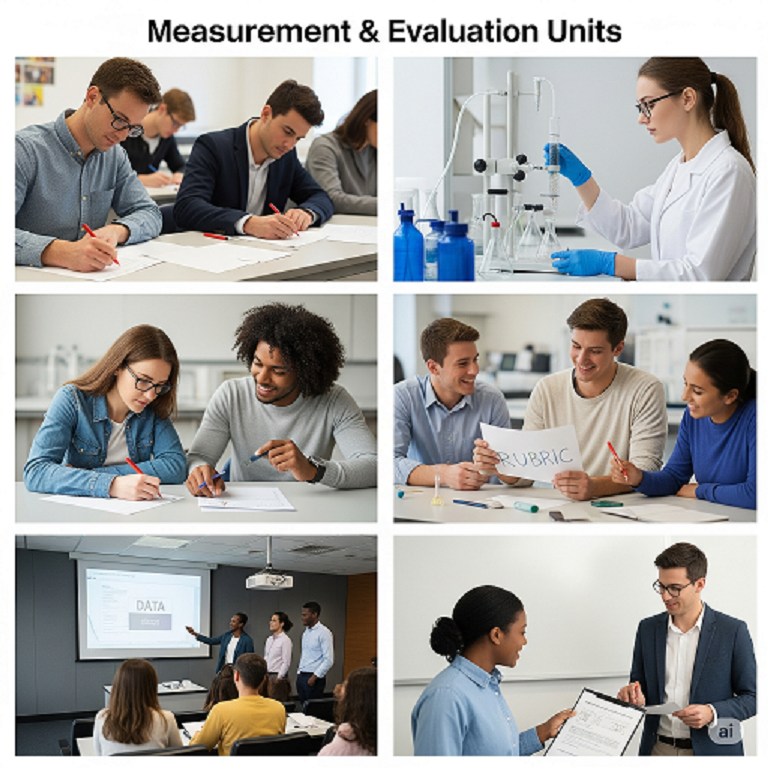
  • Rubric Training for Faculty: We train faculty members on the proper use of rubrics, promoting consistent, fair, and transparent grading practices.

  • Automated Exam Paper Generation: In collaboration with the university's Electronic Examinations Center, we've implemented a system that allows for the automated generation of exam papers directly from question banks, enhancing efficiency and security.

  • Developing OSCE Lab Handbooks: We've produced comprehensive handbooks for the OSCE Lab for both faculty and students, serving as valuable resources.

  • Regular Examination Paper Reviews: To maintain high standards, we conduct periodic reviews of examination paper specifications each semester, involving both internal and external reviewers.

جامعة حلوان

Helwan University strives to be a leading educational and research institution in technology and the arts, and excels in education and sciences according to international quality standards

  • Visits 7806
جامعة حلوان